
Record Natural Gas Withdrawals Highlight the Fragility of Winter Supply

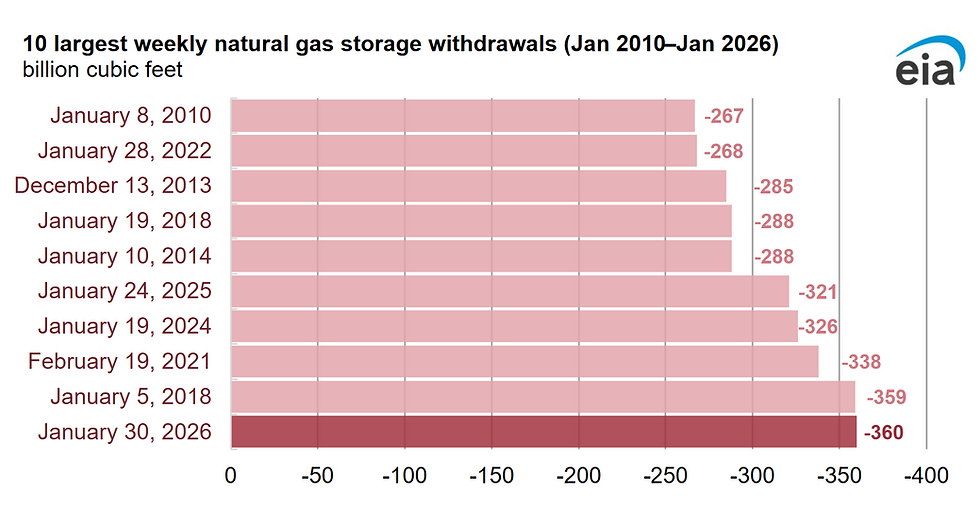
The final week of January delivered a stark reminder of how quickly U.S. natural gas fundamentals can shift when extreme weather hits. According to the U.S. Energy Information Administration, working gas stocks in the Lower 48 fell by an unprecedented 360 Bcf for the week ending January 30, 2026—the largest weekly withdrawal ever recorded,
which wasn’t a marginal deviation from normal.
The drawdown was 89% above the five‑year average, pushing inventories to 1.1% below typical levels for this time of year.
The event underscores how tightly balanced the system becomes when severe cold simultaneously drives up demand and constrains supply.
A Perfect Storm: Demand Surges, Supply Stumbles
Three forces converged to create the record-setting withdrawal:
1. Winter Storm Fern’s Nationwide Impact
A massive Arctic blast swept from New Mexico to New England, bringing extreme cold, heavy snow, and widespread ice. The scale and duration of the storm created sustained heating demand across multiple regions, not just a single cold snap in one market.
2. Heating Demand Spiked Across Sectors
Residential and commercial consumption surged. Between January 23–26, natural gas use in these sectors averaged 29% higher—or 13.9 Bcf/d more—than the five‑year norm for the same period. Electricity generators also leaned heavily on gas to meet heating‑driven load increases.
3. Production Freeze-Offs Reduced Supply
The cold didn’t just increase demand—it choked supply. Freeze‑offs and shut‑ins hit producing regions hard, including the Gulf Coast, where temperatures dipped below freezing on January 25. This contributed to the season's largest single-week production shut‑in.
Price Response: Henry Hub Surges Above $9
With demand elevated and supply constrained, price pressure was inevitable. Henry Hub spot prices jumped to $9.03/MMBtu on January 28—up $4.05 from the prior week and $5.60 above the same day last year .
Storage withdrawals play a critical role in stabilizing markets during these periods, supplementing supply when production falters. But the magnitude of this drawdown highlights how quickly storage buffers can be tested.
What This Means for Energy Stakeholders
Events like this reshape short‑term market dynamics and offer important lessons for utilities, suppliers, and large energy consumers:
Weather volatility remains the dominant risk factor for winter gas markets.
Infrastructure resilience matters—freeze‑offs can erase production gains overnight.
Storage strategy is increasingly strategic, not just operational.
Price exposure can escalate rapidly, even before peak winter months conclude.
As we move deeper into the season, all eyes will be on whether production rebounds quickly and whether additional cold snaps stress the system again.
#EnergyMarkets #ElectricityPrices #NaturalGas #PowerGeneration #Renewables #EnergyTransition #GridInsights #EIAData #EnergyManagement #WholesalePower
Would you like a review of your facility's energy plan? We are here to help!


Comments