
⚡Natural Gas MarketWatch — October 21, 2026: Front Month Breaks Below $3.00 on Persistent Mild Weather


Natural gas futures punched through the $3.00 level on Tuesday, settling at the lowest point in a month as mild forecasts for late October and early November keep heating demand on hold. But the physical market is telling a different story: Henry Hub cash hit a three-month high, LNG feedgas surged toward record levels, and the global bid for fuel stayed fierce amid escalating Middle East shipping risk. Paper is trading the weather; the physical market is trading the fundamentals.
Market Recap: Tuesday's Slide
The November NYMEX contract (front month, expires October 28) settled Tuesday at $2.963/MMBtu, down 9.5 cents (−3.11%) — its third straight decline and the lowest settlement since September 21. The contract has dropped 27.3 cents (−8.4%) over three sessions and 23.5 cents (−7.4%) week-over-week, about 10% below the $3.283 near-three-week high from October 13. It is down nearly 20% year-to-date and 60% off the $7.46 January high. Overnight electronic trading has November bouncing back above $3.01 this morning, and the winter 2026–27 strip held firmer near $3.225 (+4.5 cents) — the curve still prices winter risk even as the prompt contract sinks.
Key Drivers: Bullish vs. Bearish
Bearish weight is weather, and it is heavy. NOAA outlooks favor above-normal temperatures east of the Rockies through early November — up to 80% odds of above-normal readings in the north-central states this week — with two-week heating degree days running roughly 15–20 below normal. Ritterbusch & Associates told the WSJ the market is "almost entirely focused on mild temperature forecasts that are now stretching into next month." They warned that with the storage surplus so thin, "we can envision a sharp upside price reversal on the first sniff of renewed below-normal temps."
The bullish case is everything else. LNG feedgas ran near record levels — about 19.2 Bcf/d last week, with mid-October prints as high as 20.7 Bcf/d — and Freeport's missing train is back online. European TTF spiked to an intraday high of €90.24/MWh, its highest since December 2022, before settling at €85.06; Asian LNG spot hovered near $29.55/MMBtu. Meanwhile, the Middle East threat map widened: a small boat fired on an LNG tanker off Yemen — the first Houthi-era attack on LNG shipping — UKMTO logged its 30th vessel attack in and around the Strait of Hormuz this month, and crude flows through the strait have fallen to roughly 9.4 million b/d, about 70% of pre-war levels.
Oil bounced this morning: Brent back above $110 and WTI near $99.
Storage Fundamentals: The Surplus Keeps Shrinking
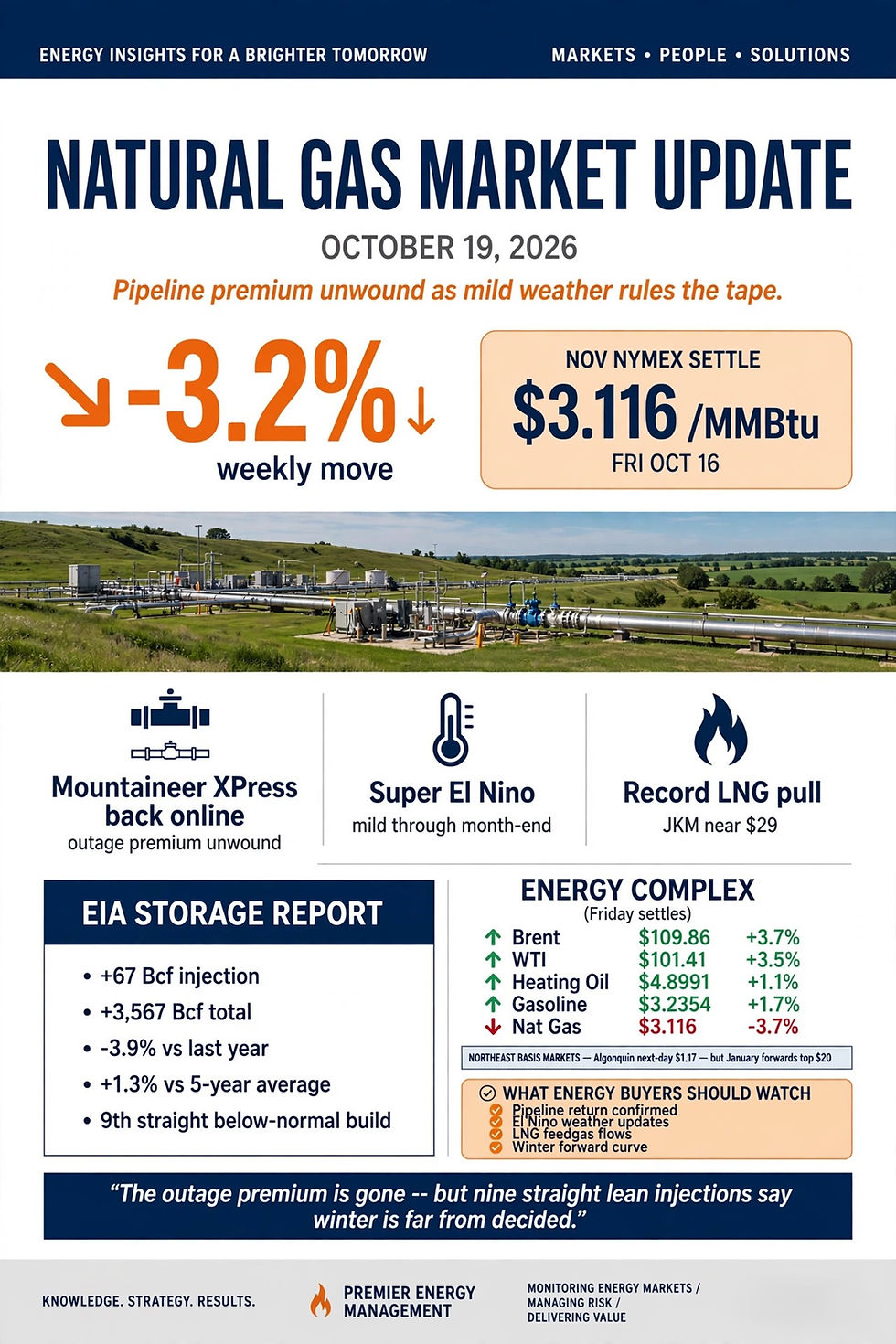
Thursday's EIA report (week ended October 9) was the eighth straight below-normal injection: 67 Bcf versus roughly 75 Bcf consensus and a 90 Bcf five-year average. Working gas stands at 3,567 Bcf—143 Bcf (−3.9%) below last year and just 45 Bcf (+1.3%) above the five-year average —a surplus that collapsed from nearly 200 Bcf late this summer. The South Central region remains the tight spot: 1,097 Bcf versus a 1,132 Bcf norm, with Gulf Coast salt caverns at 236 Bcf against a 279 Bcf average — 15% short of normal, and the storage that matters most for winter deliverability. (Thursday's report, covering the week ended October 16, is expected near 80–82 Bcf against an 87 Bcf five-year average — a ninth straight below-normal print would confirm the trend.) EIA's October outlook trimmed its end-October inventory projection by 150 Bcf to about 3,850 Bcf.
Regional Basis Markets: Cheap Today, Expensive in January
The Northeast spot market stays soft on mild weather and trapped Appalachian supply: recent next-day prints near $0.88/MMBtu at Transco Zone 6 New York and $1.17 at Algonquin Citygate — both far under Henry Hub — though a brief Monday cold snap lifted Algonquin 51 cents (+37%). Appalachian hub gas changed hands around $1.00 earlier this week. The East region enters the season adequately stocked at 884 Bcf (+3.3% above the five-year average). EIA's Winter Fuels Outlook expects gas-heated Northeast homes to see bills down about 14% this winter — versus 21% higher for oil heat — a reminder of how cheap gas looks against a heating-oil market up 132% year-to-date to $4.9250.
Production Trends: Recovering Toward Records
Lower-48 dry gas averaged roughly 111 Bcf/d in October — down from the record 113.3 Bcf/d of August–September — as Hurricane Isaias shut-ins, force majeure events, and pipeline disruptions weighed on output. The recovery is nearly complete: Gulf shut-ins are down to 0.24 Bcf/d from a 1.3 Bcf/d peak. EIA's October outlook expects winter 2026–27 production near 112.5 Bcf/d. Power burn is fading into shoulder season (35.9 Bcf/d last week, down 1.4 w/w) as wind generation surged ~78% week-over-week, leaving room for storage to build. No tropical threat menaces the Gulf: NHC reports no active Atlantic cyclones this morning.
What Energy Buyers Should Watch
Thursday's 10:30 AM ET EIA storage report (week ended Oct 16; consensus ~80–82 Bcf) — a ninth straight below-normal build confirms the tightening trend
Weather model updates into early November — the delayed heating season is the market's bearish anchor, and Ritterbusch warns cold could trigger a sharp upside reversal
LNG feedgas flows — running at or near record levels (~19–20 Bcf/d), with Cove Point maintenance ending late October
Hormuz and Red Sea developments — 30 vessel attacks in October; any shipping disruption reprices the export premium fast
Heating oil — up three straight days to $4.9250 and +132% year-to-date; dual-fuel buyers face real winter cost pressure
December crude — the prompt contract rolls this week ($97.82); watch $97–100 as the new trading anchor
Premier Energy Management Perspective
October is trading the calendar, not the fundamentals — but the fundamentals are tightening underneath it. Eight straight below-normal injections, a surplus down to 45 Bcf above normal, salt caverns 15% short, record LNG export pull, and the world's second-largest LNG exporter producing "very little" while repairs take years: every one of these is a winter problem, not an October problem. Buyers who fixate on the $2.96 front-month print risk missing the real exposure. Mild weather is cheapening near-term gas; it does nothing to fix January basis or a storage cushion that a single cold snap could erase.
Market Bottom Line
Natural gas broke below $3.00 on weather, not supply — the front month at $2.963 after a three-session 8.4% slide, weighed down by forecasts of above-normal temperatures stretching into November. But storage is tightening week by week, LNG exports are running at record levels, and Middle East supply risk is rising by the day.
For commercial and industrial buyers, calm prompt prices are the time to structure winter coverage: lock the basis where exposure is known, and don't let a warm October mask January risk.
#NaturalGas #EnergyMarkets #PEMInsights #MarketWatch #EnergyStrategy #PremierEnergyManagement #NYMEX #NaturalGasStorage #EIAStorageReport #EnergyProcurement #EnergyRiskManagement #BasisMarkets #CommercialEnergy #IndustrialEnergy #LNG #EnergyAnalytics #CommodityMarkets #WinterOutlook #MarketVolatility #StrategicProcurement #SupplyChainResilience #EnergyLeadership
Winter is almost here...
Would you like a review of your facility's Winter Energy strategy? We are here to help!


Comments