
⚡Natural Gas MarketWatch — October 20, 2026: Front Month HitsThree-Week Low on Mild Weather


The energy complex split in two on Monday: crude oil notched its eighth straight daily gain on escalating Middle East risk. At the same time, natural gas slid to its lowest settlement since October 2 as mild late-October weather overpowered a bullish-leaning storage print and record Asian LNG prices. Near-term fundamentals are bearish, but the geopolitical backdrop keeps export demand firmly intact.
Market Recap: Monday's Slide
The November NYMEX contract (front month, expires October 28) settled Monday at $3.058/MMBtu, down 5.8 cents (−1.86%). That extends a two-session slide of 17.8 cents (−5.5%) and puts the contract roughly 7% below Tuesday's near-three-week high of $3.283 — the lowest close since October 2. Overnight electronic trading has November bouncing a few cents, near $3.09 this morning. The winter 2026–27 strip sits near $3.24, down about 15 cents week-over-week, while EIA's October outlook has Henry Hub averaging $3.30 in Q4 and $3.47 in Q1 2027 — roughly where the curve already sits, with weather deciding the outcome.
Key Drivers: Bullish vs. Bearish
Bearish weight is winning the tape. NOAA outlooks favor above-normal temperatures across most of the eastern U.S. through early November, with two-week heating degree days about 10% below the 10-year norm and residential demand (~5.1 Bcf/d) trailing its ~7.5 norm — the heating season is simply delayed. Gulf of Mexico shut-ins from Hurricane Isaias have nearly cleared, and no new tropical threat menaces LNG facilities: Invest 93L off the Carolinas is tracking northeastward away from the coast.
The bullish case is external. Asian LNG spot hit $30.40/MMBtu Monday — its highest since December 2022 — after an LNG carrier came under fire off Yemen, and European TTF traded near €87.90/MWh. Roughly 17% of Qatar's Ras Laffan liquefaction is damaged, and crude flows through the Strait of Hormuz have fallen to about 8.5 million b/d (seven-day average) from over 20 million. The trans-Atlantic bid for U.S. LNG is intense: feedgas should rebound to a five-month high near 18.9 Bcf/d by Friday.
Storage Fundamentals: The Surplus Keeps Shrinking
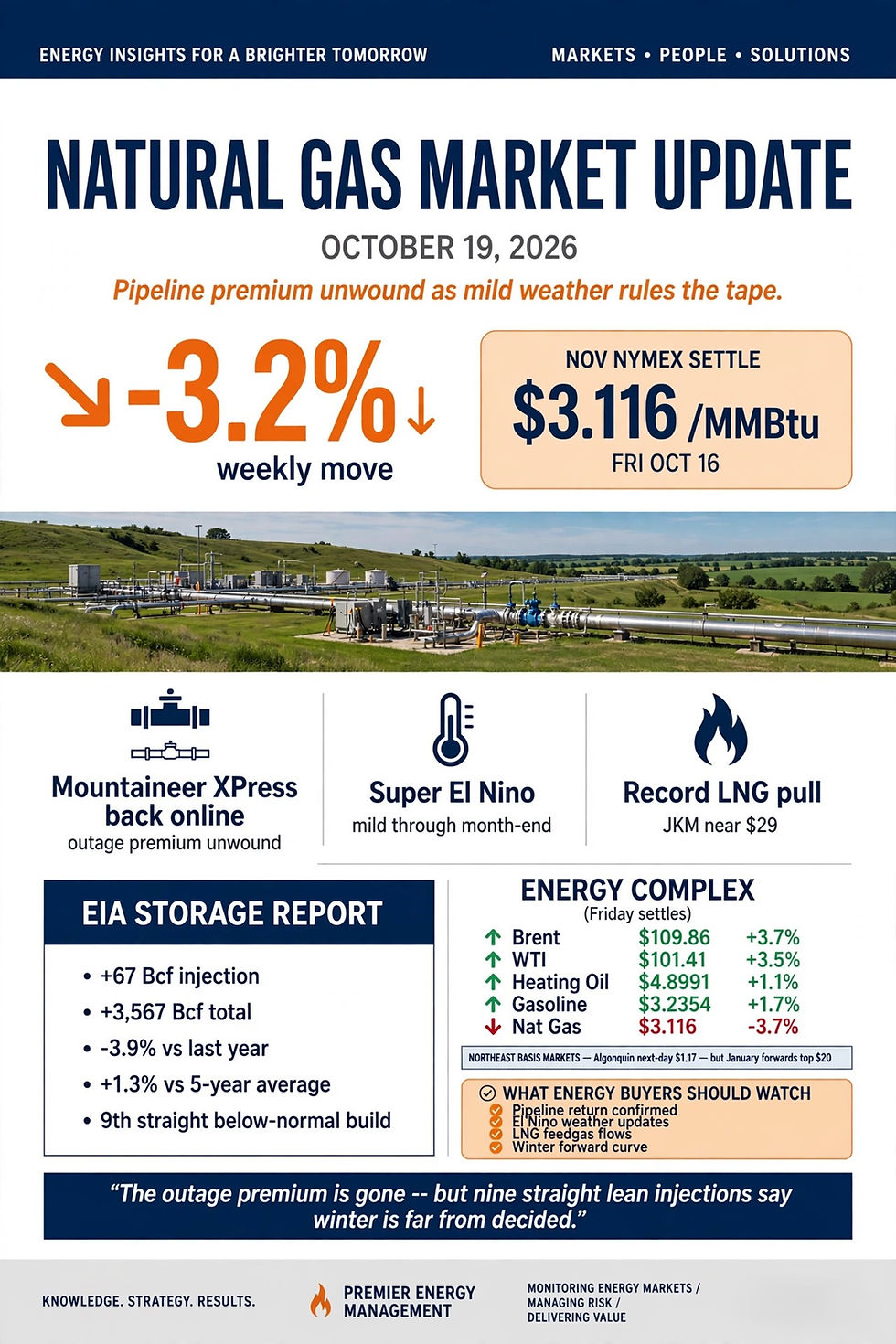
Thursday's EIA report (week ended October 9) was the ninth straight below-normal injection: 67 Bcf versus ~75 Bcf consensus and a ~90 Bcf five-year average. Working gas stands at 3,567 Bcf — 143 Bcf (−3.9%) below last year and just 45 Bcf (+1.3%) above the five-year average, a surplus that has collapsed from nearly 5% in early September. The South Central region is the tight spot: 1,097 Bcf versus a 1,132 Bcf norm, with Gulf Coast salt caverns at 236 Bcf against a 279 Bcf average — the storage that matters most for winter deliverability. (The next report, covering the week ended October 16, is out Thursday at 10:30 AM ET.) EIA still projects end-October inventories near 3,850 Bcf, about 2% above the five-year average — enough, for now.
Regional Basis Markets: Cheap Today, Expensive in January
The Northeast spot collapse continued: next-day gas at Transco Zone 6 New York near $0.88/MMBtu and Algonquin Citygate near $1.17 — both deeply under Henry Hub — while Appalachian hub Dominion South sat at just $0.61. Winter tells the opposite story: January 2027 forward tops $20/MMBtu at Algonquin, roughly $17 in Boston and ~$9 in New York — more than five times Henry Hub. Northeast storage near 806 Bcf sits about 60 Bcf below the five-year average and roughly 250 Bcf short of typical pre-winter levels, requiring about 3.6 Bcf/d of injections over the remaining ~8 weeks. Watch Enbridge's proposed Project Beacon (300 MMcf/d of added Algonquin capacity, targeted for November 2030) — nothing arrives in time for this winter.
Production Trends: Recovering, Not Yet Restored
Lower-48 dry gas averaged 110.8 Bcf/d so far in October — down from the record 113.3 Bcf/d in August–September — on hurricane shut-ins, force majeure events, and pipeline interruptions, including Columbia Gas Transmission's second force majeure in three weeks. LNG feedgas softened to ~17.5–17.6 Bcf/d in October versus 17.9 in September as Freeport's Train 2 sits in maintenance and Cove Point is offline for seasonal work into late October. Shoulder-season power burn is easing, and wind generation is strong, pushing more gas into storage.
What Energy Buyers Should Watch
Thursday's 10:30 AM ET EIA storage report (week ended Oct 16) — a tenth straight below-normal build tightens the story
Weather model updates into early November — the delayed heating season is the market's bearish anchor
LNG feedgas flows — LSEG sees ~18.9 Bcf/d by Friday, a five-month high
Hormuz and Red Sea developments — any disruption reprices the export premium fast
January Northeast basis — the hedge window for cold-snap exposure before winter arrives
Premier Energy Management Perspective
October is trading the calendar, not the fundamentals. Mild weather is cheapening near-term gas, but the buffer is thinner than it looks: nine straight below-normal injections, a surplus down to 45 Bcf above the five-year average, and tight salt-cavern storage in the Gulf. Meanwhile, the world is paying over $30/MMBtu for LNG and U.S. export capacity is essentially full. Buyers who fixate on the $3.06 front-month print risk missing the real exposure: a $20 January basis in New England and a winter strip that reprices sharply on the first sustained cold or the next production disruption.
Market Bottom Line
Natural gas opens the week defensive — the front month at $3.058 after a two-session 5.5% slide, weighed down by mild weather forecasts and recovering production. But storage is tightening, the global bid for U.S. LNG is at multi-year highs, and Middle East supply risk is rising by the day. For commercial and industrial buyers, calm markets are the time to structure winter coverage: lock the basis where exposure is known, and don't let a warm October mask January risk.
#NaturalGas #EnergyMarkets #PEMInsights #MarketWatch #EnergyStrategy #PremierEnergyManagement #NYMEX #NaturalGasStorage #EIAStorageReport #EnergyProcurement #EnergyRiskManagement #BasisMarkets #CommercialEnergy #IndustrialEnergy #LNG #EnergyAnalytics #CommodityMarkets #WinterOutlook #MarketVolatility #StrategicProcurement #SupplyChainResilience #EnergyLeadership
Winter is almost here...
Would you like a review of your facility's Winter Energy strategy? We are here to help!


Comments