
⚡Natural Gas MarketWatch — October 19, 2026: Pipeline Premium Unwinds as Mild Weather Rules the Tape

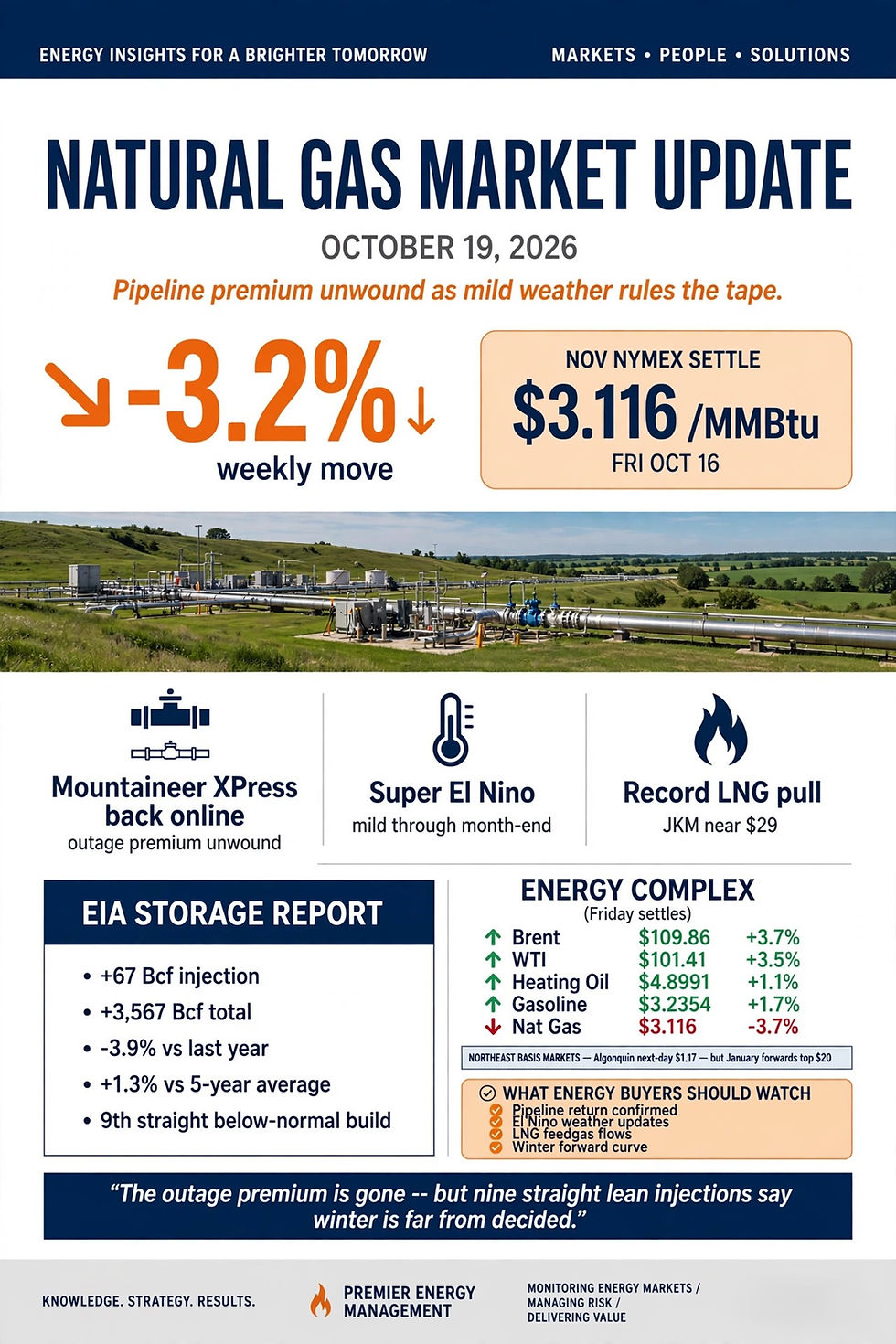
The market's focus this week is the speed of a reversal: Friday's session erased the pipeline-outage premium in a single day, and a mild weather outlook is now setting the tone heading into the final stretch of injection season.
Market Recap: Friday's Unwind
The November NYMEX contract (front month, expires October 28) settled Friday at $3.116/MMBtu, down 12 cents (−3.7%) on the day and about 3.2% on the week — the steepest single-day drop in nearly three weeks. Intraday, the contract fell more than 5%, and the settle marked the lowest close since October 6, wiping out Tuesday's near-three-week high of $3.283. The 50-day moving average near $3.07 held Friday's low. Early Monday trading has November near $3.11–3.14, roughly flat to Friday's settle, with the Henry Hub spot benchmark near $3.14 this morning.
Key Drivers: Bullish vs. Bearish
Bearish momentum has the tape. TC Energy said its Mountaineer XPress line on the Columbia Gas Transmission system would return to service over the weekend, removing the second Appalachian outage premium in three weeks. Production is rebounding toward 113–114 Bcf/d as Gulf of Mexico shut-ins from Hurricane Isaias continue to clear. And weather is the bigger weight: forecasts keep mild conditions in place through month-end, while NOAA's winter outlook (released Thursday) favors a super El Niño — the Pacific event is tracking to be the strongest on record since 1950, with warmer-than-normal odds across the northern U.S.
Bullish support is structural, not immediate. Thursday's EIA report was the ninth straight below-normal injection, the storage surplus has shrunk to just 1.3% above the five-year average, and the global pull is intense: Asian JKM near $29.93 and European TTF around $28.55/MMBtu — its highest since December 2022 — keep U.S. LNG feedgas pinned near capacity at 17–18+ Bcf/d.
Storage Fundamentals: The Cushion Keeps Thinning
For the week ended October 9, EIA reported a 67 Bcf injection — below the ~74–75 Bcf consensus and below the 90 Bcf five-year average. Working gas stands at 3,567 Bcf: 143 Bcf (−3.9%) below last year and 45 Bcf (+1.3%) above the five-year average. This was the ninth consecutive below-normal build, and the surplus has narrowed sharply from nearly 5% in early September. (The next report, covering the week ended October 16, is out Thursday at 10:30 AM ET.) The EIA's October outlook still projects end-October inventories near 3,850 Bcf, about 2% above the five-year average — enough, for now.
Regional Basis Markets: Two Markets, One Region
The Northeast remains a study in contrasts. Warm shoulder-season weather has collapsed next-day pricing: Algonquin Citygate traded at $1.17, Transco Zone 6 New York at $0.88, and Appalachian hub Dominion South at just $0.61 — all deeply under Henry Hub. But winter tells the opposite story: January forwards at Algonquin are topping $20/MMBtu, more than five times the Henry Hub benchmark, as traders price the region's chronic pipeline constraint. Any sustained cold snap risks the familiar basis blowout. Watch Enbridge's proposed Project Beacon (300 MMcf/d of added Algonquin capacity) and the push from Massachusetts Governor Healey for a ~75 MMcf/d expansion — neither arrives in time for this winter.
Production Trends: Rebuilding Fast
Lower-48 dry gas production is recovering quickly from the early-October lows near 107 Bcf/d, with current reads near 113–114 Bcf/d — back toward the August–September records. Gulf of Mexico shut-ins from Isaias have fallen from 59% to roughly 25%. With power burn declining in shoulder season and LNG feedgas running 17.4–18.4 Bcf/d, the near-term balance is comfortable. The question is whether production holds through November against the repair schedule and the start of heating demand.
What Energy Buyers Should Watch
Thursday's 10:30 AM ET EIA storage report (week ended Oct 16) — another below-normal build tightens the story further
Confirmation that Mountaineer XPress fully returned to service over the weekend
Weather model updates and the November El Niño/ENSO update — the main winter risk input
LNG feedgas flows and the trans-Atlantic price pull (TTF/JKM near multi-year highs)
The winter forward curve and Algonquin January basis — the hedge window for cold-snap exposure
Premier Energy Management Perspective
Friday's selloff reminds us that October markets trade the news cycle, not the winter. The pipeline outage premium built quickly and unwound faster — but the underlying tightness is real: nine straight below-normal injections, a shrinking surplus, and a record global bid for U.S. LNG. Buyers watching only the front-month settle will miss the risk sitting in January forwards, where New England winter exposure remains severe. The mild El Niño outlook is the market's current excuse to sell; one model shift toward sustained cold, or a fresh production disruption, reprices the curve sharply.
Market Bottom Line
Natural gas enters the week defensively — the front month at $3.116 after Friday's intraday washout, weighed down by a returning pipeline, mild late-October weather, and a super El Niño winter outlook. But storage is tighter than the headlines suggest and the world is bidding hard for U.S. molecules. For commercial and industrial buyers, the message hasn't changed: use calm markets to structure winter coverage, and don't let a warm October mask a $20 January basis risk in the Northeast.
#NaturalGas #EnergyMarkets #PEMInsights #MarketWatch #EnergyStrategy #PremierEnergyManagement #NYMEX #NaturalGasStorage #EIAStorageReport #EnergyProcurement #EnergyRiskManagement #BasisMarkets #CommercialEnergy #IndustrialEnergy #LNG #EnergyAnalytics #CommodityMarkets #WinterOutlook #MarketVolatility #StrategicProcurement #SupplyChainResilience #EnergyLeadership
Winter is almost here...
Would you like a review of your facility's Winter Energy strategy? We are here to help!


Comments