
Bearish Storage Report and Heatwave Pricing Keep Markets Range‑Bound

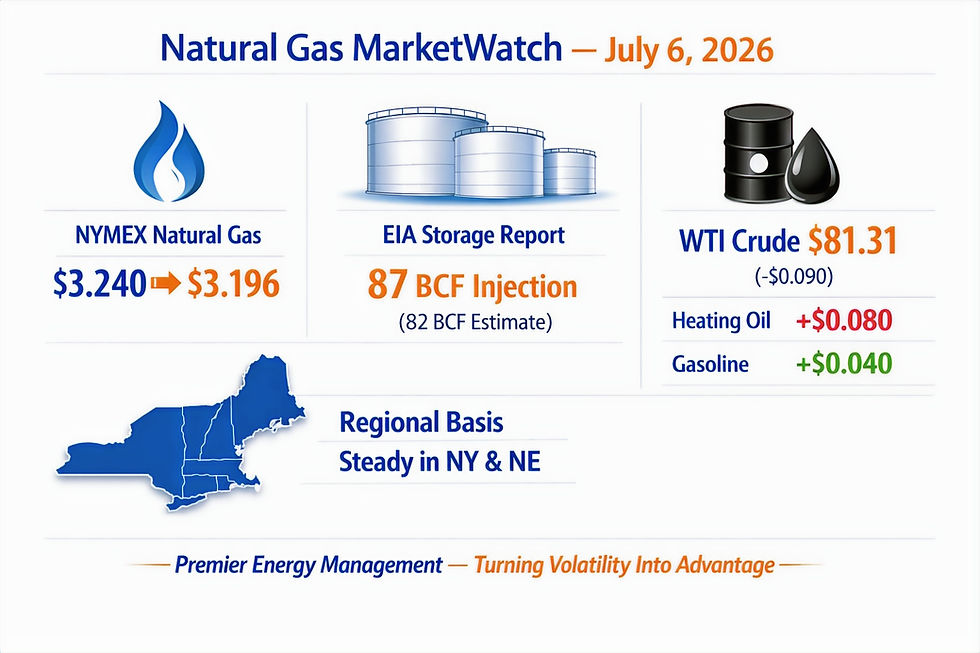
Thursday, July 2 saw the front‑month NYMEX Natural Gas contract open at $3.240, slightly below Tuesday’s close of $3.220. With the current heatwave already priced into the market, traders awaited the bearish‑leaning EIA Storage Report released at 10:30 AM. Prices hovered near $3.200 before dipping to an intraday low of $3.151 following the above‑average injection. The contract then staged a mild recovery into the afternoon, recording an intraday high of $3.213 at 1:55 PM and closing lower at $3.196.
🔹 Storage and Supply Dynamics
The EIA Natural Gas Storage Report published Thursday posted an 87 BCF injection for the week ended June 26 — in line with the market estimate of 82 BCF. Working gas in storage was reported at 2,922 BCF, 0.8 % below this time last year and 6.4 % above the five‑year average. The data confirms a market that remains well‑supplied even amid seasonal cooling demand.
🔹 Crude and Refined Products
In early Globex trading, WTI Crude was down $0.090 at $81.31, while Heating Oil gained $0.080 and Gasoline rose $0.040. The mixed movement across refined products reflects divergent fundamentals — crude softness tied to inventory builds and macroeconomic caution, versus gasoline strength driven by summer travel demand.
🔹 Regional Basis Trends
New York and New England basis values were unchanged across all seasons, with slight weakness in New York and modest firmness in New England. The regional divergence underscores localized pipeline constraints and temperature differentials, factors that continue to shape short‑term basis spreads.
🔹 Weather and Demand Outlook
Forecast models show temperatures remaining above average across the Mid‑Atlantic
and South, sustaining elevated cooling loads. The ERCOT and Southeast markets continue to rely heavily on gas‑fired generation for grid reliability, while milder conditions in the Midwest and Northeast temper overall demand. This regional balance keeps national consumption steady and supports a range‑bound price environment.
🔹 Strategic Implications for Procurement
For commercial and industrial consumers, the current setup favors incremental hedging rather than aggressive forward locking. With storage builds steady and volatility subdued, short‑term procurement strategies can capitalize on dips while maintaining flexibility for late‑summer adjustments.
Longer‑term buyers should monitor basis spreads, regional weather patterns, and crude correlations, as these factors can quickly shift cost structures. The interplay between storage injections, cooling demand, and macro energy trends will define price behavior through July.
🔹 PEM Perspective
At Premier Energy Management, we help clients interpret these signals — aligning procurement timing with market fundamentals to manage risk and capture opportunity.
Our approach integrates real‑time data, regional basis analytics, and weather‑driven forecasting to ensure decisions are grounded in actionable insight.
As the summer unfolds, disciplined risk management and data‑driven strategy remain essential to navigating evolving supply‑demand dynamics. The market may be calm today, but volatility never stays dormant for long — and preparation is the best hedge.
#NaturalGas #EnergyMarkets #EIA #StorageReport #WTICrude #EnergyTrading #RiskManagement #PremierEnergyManagement #PEM #Volatility #EnergyStrategy #MarketWatch #GasPrices #EnergyInsights #Procurement #BasisRisk #WeatherForecasts #EnergyInfrastructure #CoolingDemand #GridReliability
Would you like a review of your facility's energy plan? We are here to help!


Comments