
⚡Natural Gas MarketWatch — October 14, 2026: Isaias Exits, Storage Swells, and New England Defies the El Niño Script


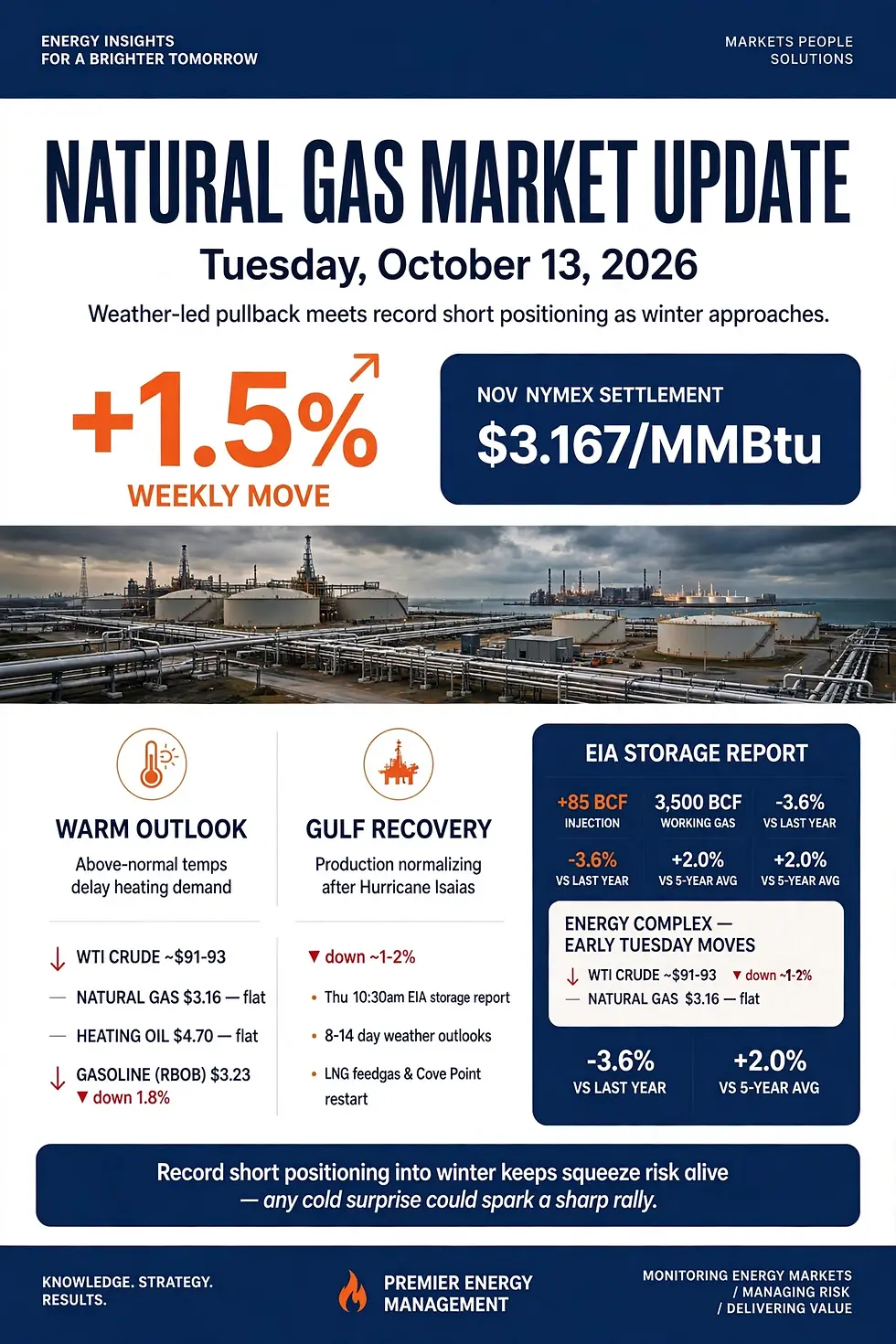
The natural gas market opened the week up again, with the season's first hurricane behind it. Hurricane Isaias made landfall near Destin, Florida, on Friday as a Category 2 storm and dissipated over the Southeast by Monday, after idling up to 59% of Gulf of Mexico gas production. Traders turned their attention to a record-sized storage injection, near-record LNG exports, and a historically strong El Niño forming for winter 2026–27. The November NYMEX contract settled Tuesday at $3.283/MMBtu, up 11.6 cents (+3.66%) on the session and 6.1% for the week, posting its highest close since September 24.
Market Recap: Climbing the Storm Wall
The November contract — front month since the October contract expired September 28 — settled Tuesday at $3.283/MMBtu, its largest one-day gain and highest settlement since September 24. The contract gained 6.1% for the week ended October 9, is up roughly 8.5% month-to-date, and remains down about 40 cents (11%) year-to-date. The broader energy complex split: WTI crude traded near $95 this morning (+0.9%), Brent near $106, heating oil (Nov) surged 4.67% to $4.944/gal on an IEA warning of diesel tightness into 2027, while RBOB gasoline slipped 1.5% to $3.24/gal.
Key Bullish and Bearish Drivers
Bullish: Isaias shut in 59% of Gulf gas output (1.3 Bcf/d) and 72% of Gulf oil (1.5 MMb/d) at its peak; offshore production was still recovering midweek, with Lower-48 output pulled back to 107–108 Bcf/d. LNG feedgas held near record levels at 18.1 Bcf/d despite Freeport Train 2 maintenance (ongoing since Oct 2) and Cove Point's outage into late October. Europe's TTF benchmark hit 86.93/MWh Tuesday — its highest since December 2022 — as Qatari LNG remains blocked by Strait of Hormuz disruptions, keeping every operable U.S. terminal running flat out.
Bearish: The EIA reported an 85 Bcf injection for the week ended October 2 — the largest build since late June and above the 79–80 Bcf consensus. A historic-strength El Niño is forming for 2026–27, which typically trims northern-tier heating demand by 5–12%. Winter forward strips sit at their lowest levels of the year, and mild near-term U.S. weather is delaying the start of heating season.
Storage Fundamentals: Building Faster
Working gas in storage stood at 3,500 Bcf as of October 2, up 85 Bcf from the previous week. Inventories were 130 Bcf below last year at this time (-3.6%) but 68 Bcf above the five-year average of 3,432 Bcf (+2.0%) — still within the five-year range. Builds have accelerated across four straight reports: +44 → +53 → +64 → +85 Bcf.
Note: this week's report (week ended October 9) is not released until Thursday at 10:30 AM ET; analysts are forecasting a +74 Bcf build, which would narrow the surplus to the five-year average to 52 Bcf.
Regional Basis Markets: New England Stays Its Own Animal
While Henry Hub January forwards trade below $4, New England natural gas forwards are topping $20/MMBtu for January 2027 at key hubs including Algonquin Citygate — more than five times the national benchmark. The problem is not supply; it is pipe. More than a decade of blocked pipeline projects means the region cannot pull Marcellus gas enough on cold days. A new Enbridge proposal, Project Beacon, would add 300 MMcf/d of firm capacity to the Algonquin system (service targeted as early as November 2030) and could cut average winter Algonquin Citygate prices by $1.27/MMBtu, per a study for the Fiscal Alliance Foundation. Until then, any cold snap risks the familiar basis blowout — and with heating oil projected 54% higher this winter, dual-fuel generators have less cushion than usual.
Production Trends: Soft, Then Softer, Then Rebuilding
Lower-48 dry gas production pulled back to roughly 107–108 Bcf/d midweek on lingering Isaias shut-ins, off recent highs near 111 Bcf/d. Northeast production held around 33.5 Bcf/d, about 3 Bcf/d below mid-September highs. Canadian imports averaged 5.1 Bcf/d; pipeline exports to Mexico ran 7.2 Bcf/d; LNG feedgas averaged 18.1 Bcf/d on the week. In aggregate, the supply picture remains ample — the question this winter is timing and deliverability, not molecules.
What Energy Buyers Should Watch
Thursday 10:30 AM ET EIA storage report (week ended Oct 9) — Analyst expects +74 Bcf
Gulf production recovery trajectory and lingering offshore outage nominations
NOAA/CPC El Niño strength updates and the November winter outlook
European TTF and Strait of Hormuz developments — the trans-Atlantic pull on U.S. LNG
Algonquin Citygate and Tennessee Zone 6 winter forward moves
Freeport Train 2 and Cove Point return timelines
Premier Energy Management Perspective
The market is sending two signals at once. The Henry Hub benchmark says winter will be comfortable: storage is building fast, a historically strong El Niño points to mild heating demand, and forwards sit at yearly lows. The basis markets say something else entirely: $20-plus New England January gas and heating oil projected 54% higher tell us deliverability risk — not supply risk — is the real threat this winter. For commercial and industrial buyers in the Northeast, the procurement window on the benchmark looks attractive, but basis exposure into constrained pipes deserves as much attention as the outright price.
Market Bottom Line
With Hurricane Isaias dissipated, and an 85 Bcf storage injection calming the prompt market, November gas at $3.283 is fairly priced between a bullish LNG/export backdrop and a bearish El Niño winter setup. Tomorrow's storage report and the New England basis are the real tells from here.
#NaturalGas #EnergyMarkets #PEMInsights #MarketWatch #EnergyStrategy #PremierEnergyManagement #NYMEX #NaturalGasStorage #EIAStorageReport #EnergyProcurement #EnergyRiskManagement #BasisMarkets #CommercialEnergy #IndustrialEnergy #LNG #EnergyAnalytics #CommodityMarkets #WinterOutlook #MarketVolatility #StrategicProcurement #SupplyChainResilience #EnergyLeadership
Winter is almost here...
Would you like a review of your facility's Winter Energy strategy? We are here to help!


Comments