
⚡Natural Gas MarketWatch — October 13, 2026: Weather Weighs on Gas as Bulls Wait for Winter

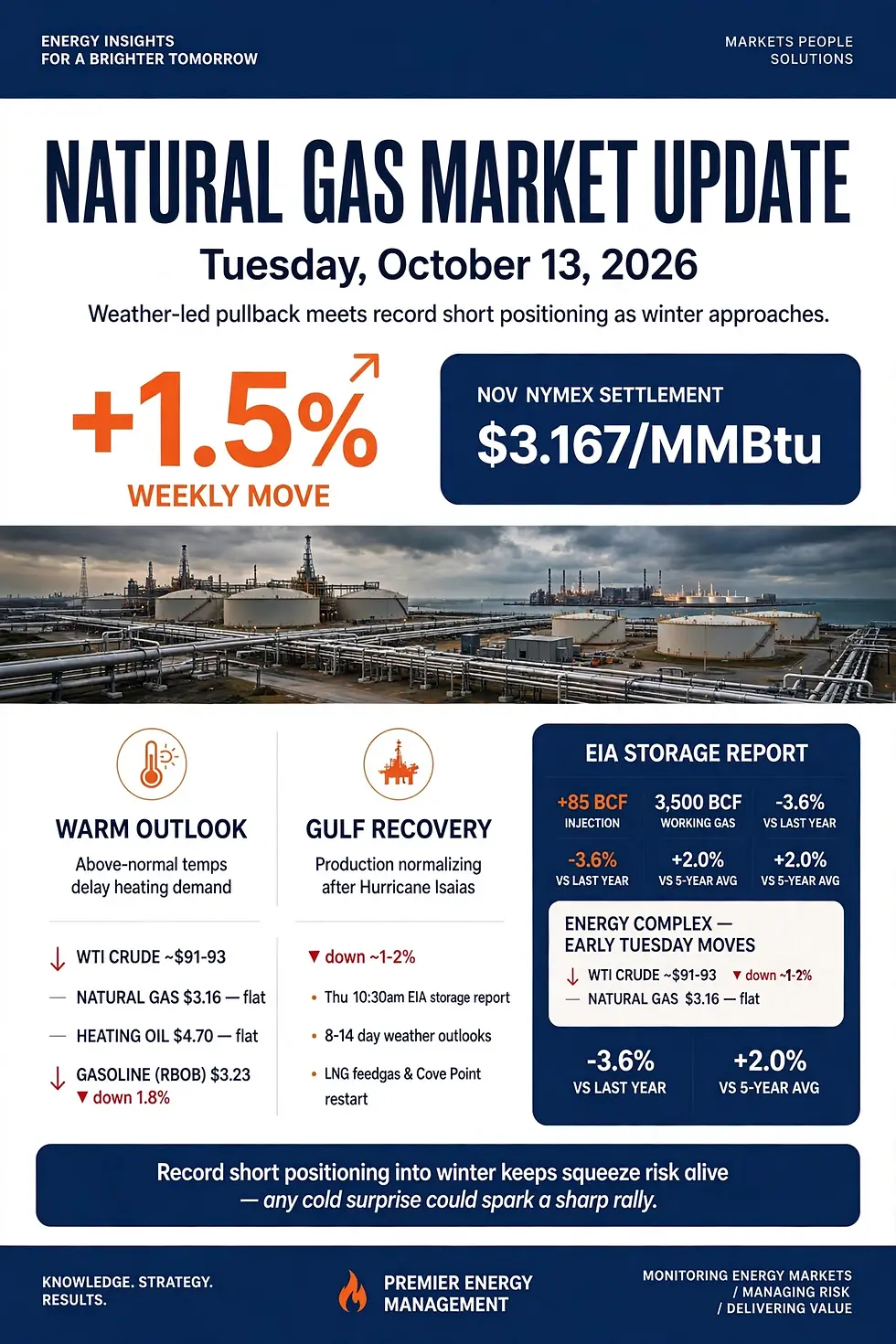
Natural gas futures are treading water near $3.16 this morning after Monday's weather-led slide delivered the largest one-day loss in nearly two weeks. The market is caught between a warm shoulder-season outlook that keeps delaying heating demand and a post-storm Gulf supply recovery — yet managed money sits at its most net-short since November 2024, leaving gas coiled for a sharp rally if winter arrives early or any supply surprise emerges.
Market Recap
The November NYMEX contract (NGX26, expiring October 28) traded near $3.16/MMBtu in early Tuesday action, down about 0.2% in a tight $3.157–$3.191 range. Monday told the real story: the contract settled at $3.167, down 1.65% (5.3¢) — the biggest one-day decline since October 1 — after trading $3.092–$3.204. Henry Hub spot sits near $3.13. Despite the pullback, gas remains up about 1.5% on the week from $3.114 on October 6. The contrast overseas is stark: Dutch TTF rose 1.8% to €85.85/MWh on Tuesday, its highest since December 2022, as disrupted Hormuz flows strand nearly a fifth of global LNG supply.
Key Bullish Drivers
Positioning is the market's coiled spring. Managed money is the most net short (-145,000 contracts) since November 2024 — prime fuel for a squeeze on any bullish headline. Gulf supply is still normalizing post-Hurricane Isaias (roughly 531 MMcf/d remained offline midday Monday versus 1.3 Bcf/d Friday), and any offshore damage assessment would jolt prices. Europe's tightness looms: Qatari LNG exports are halted, and EU storage is only ~73% full versus an 89% five-year average. And the Algonquin Citygate winter strip tops $13, while East Coast distillate stocks sat 32% below the five-year average in September — the Northeast's winter vulnerability is real.
Key Bearish Drivers
Warm weather is the price of admission. Above-normal temperatures are forecast across much of the U.S. in the 11-to-15-day window, with Commodity Weather Group calling for an above-average eastern U.S.
October 22–26 — postponing heating demand just as withdrawal season approaches. Gulf production is recovering daily, and LNG feedgas has bounced back toward 18–19 Bcf/d as Freeport's Train 2 returns from maintenance and Cove Point's restart is expected in the coming days.
The structural overhang: "Super El Niño" expectations point to a warmer winter (EIA sees the season ~3% warmer than the 10-winter average), and end-October storage is projected near decade-high levels of roughly 3,850–3,985 Bcf.
Storage Fundamentals
The latest EIA storage report (week ended October 2, released October 8) showed an 85 Bcf injection versus the 79 Bcf consensus — below the five-year average build of 96 Bcf. Working gas stands at 3,500 Bcf, 130 Bcf below last year but 68 Bcf above the five-year average of 3,432 Bcf. This was the seventh straight week of below-normal injections, and South Central salt storage is 15.5% below its five-year average. The next report, covering the week ended October 9, drops Thursday at 10:30 a.m. ET.
Regional Basis Markets
Northeast basis remains the winter wildcard. The Algonquin winter strip above $13 reflects chronic pipeline constraints that turn every cold snap into a basis blowout. The dynamic drew fresh attention Monday, when Massachusetts Governor Healey asked federal regulators to accelerate a modest pipeline expansion (~75 MMcf/d, ~2% of Algonquin capacity). Meanwhile, the Jones Act waiver for LNG shipments into the Northeast runs through November 15 — a limited backstop. With New England storage forecast to enter winter at only the five-year average, sustained cold could reprice regional basis violently.
Production & Supply Trends
Lower-48 dry gas production slid from its August–September record of 113.3 Bcf/d to roughly 111.2 Bcf/d so far in October, dipping during the storm before recovering; pipeline force majeure events in Kentucky, Texas, and West Virginia are also curbing output. LNG feedgas is running 18–19 Bcf/d — below April's 18.8 record, with Golden Pass flowing about 50% below recent highs. Lower-48 demand, including exports, is sliding from 106.6 to 104.0 Bcf/d this week on the warm outlook, while Mexican exports hold steady at 7.2 Bcf/d.
Broader Energy Complex
Crude is softer as geopolitics cuts both ways. WTI trades near $91–$93/bbl, down ~1–2%, pulling back from Monday's near-two-week high (~$93.7) after Trump announced a Russia diesel deal — an OFAC license authorizing Russian diesel imports through April 2027. But a
roughly $20/bbl geopolitical premium persists: weekend Houthi strikes killed 13 at Riyadh's airport, tankers were hit near Oman and in the Strait of Hormuz, and the claimed Russia-Ukraine "energy ceasefire" is already disputed.
Brent holds near $105 (Goldman raised its December Brent forecast to $90). Heating oil settled at $4.7232/gal (-0.32%) and trades near $4.70; RBOB gasoline is $3.2310/gal (-1.84%), though the AAA national average hit an October record $4.36/gal with diesel at $6.27/gal. OPEC slashed 2026 demand growth to 400,000 bpd, and the G7 agreed to release up to 100 million barrels via the IEA — with a diesel tranche in the first 20 days.
What Energy Buyers Should Watch
Thursday's 10:30 a.m. ET EIA storage report (week ended Oct 9) —another below-normal build tightens the story
8-to-14-day weather outlooks — any cold-air shift into the Northeast or Midwest flips the demand math fast
Gulf offshore recovery and any Isaias damage reports
LNG feedgas and Cove Point's restart — exports are the marginal buyer
Hormuz and TTF headlines — Europe's supply stress can spill into U.S. sentiment
Winter procurement windows — with record short positioning and $13+ Algonquin winter strips, consider locking fixed prices on dips
Premier Energy Management Perspective
This market is pricing perfect weather against imperfect supply. Shoulder-season warmth and recovering Gulf production are legitimate near-term weights, but the setup underneath is anything but relaxed: storage surpluses are shrinking for the seventh straight week, managed money is the most short in two years, Europe is paying its highest prices since 2022, and Northeast winter basis risk is already flashing on the Algonquin strip.
For commercial and industrial buyers, this is the window that matters — weakness in the prompt month is an opportunity to fix winter exposure before the first sustained cold snap forces your hand.
Market Bottom Line
Natural gas is consolidating near $3.16 after Monday's weather-driven 1.65% slide, with warm outlooks and recovering Gulf supply keeping sellers in control for now. But record net-short positioning, shrinking storage surpluses, Europe's LNG tightness, and a $13+ Algonquin winter strip argue that downside is limited and upside risk is very much alive as winter approaches.
#NaturalGas #EnergyMarkets #PEMInsights #MarketWatch #EnergyStrategy #PremierEnergyManagement #NYMEX #NaturalGasStorage #EIAStorageReport #EnergyProcurement #EnergyRiskManagement #BasisMarkets #CommercialEnergy #IndustrialEnergy #LNG #EnergyAnalytics #CommodityMarkets #WinterOutlook #MarketVolatility #StrategicProcurement #SupplyChainResilience #EnergyLeadership
Winter is almost here...
Would you like a review of your facility's Winter Energy strategy? We are here to help!


Comments