
⚡Natural Gas MarketWatch — October 1, 2026: October Begins with Resilient Price Action and Strong Winter Market Signals

As the market turns the calendar to October, natural gas traders continue balancing comfortable fall temperatures against tightening production dynamics and growing winter positioning. While weather remains relatively mild across much of the country, Wednesday's trading session demonstrated that the market remains highly sensitive to supply fundamentals and storage expectations.
For commercial and industrial energy consumers, this environment reinforces the importance of maintaining disciplined procurement strategies while closely monitoring storage trends, basis market movements, and production activity heading into the heating season.
📈 Market Recap: Natural Gas Fights to Hold the $3.00 Level
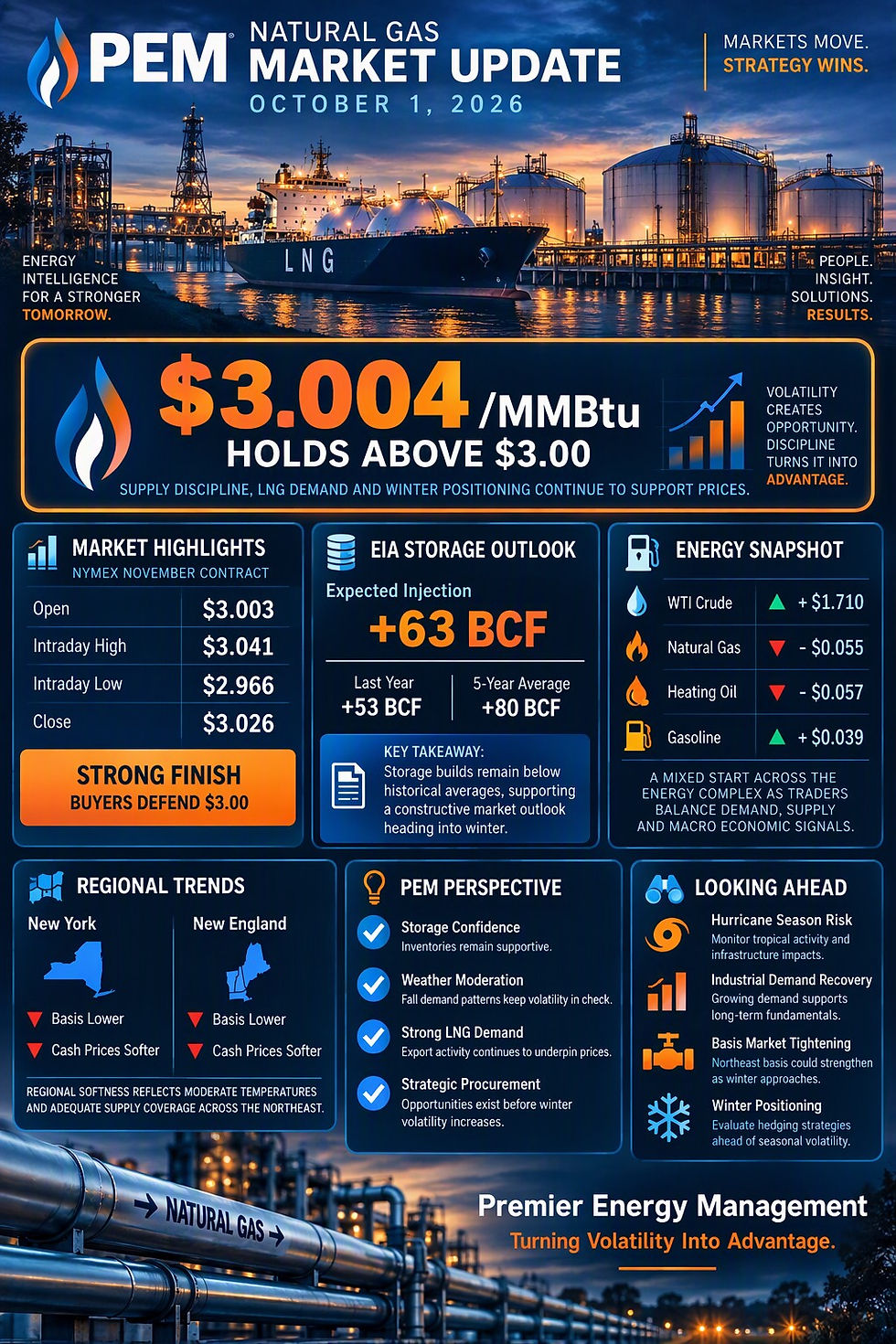
Wednesday, September 30, saw the front-month NYMEX Natural Gas contract open at $3.003/MMBtu, just $0.008 below Tuesday's settlement of $3.011/MMBtu. Throughout the morning, traders monitored production levels while largely comfortable autumn temperatures kept demand expectations in check.
The market weakened early in the session, falling to an intraday low of $2.966/MMBtu at 9:55 AM. However, buyers quickly returned as the market attempted to defend the psychologically important $3.00 threshold. Prices strengthened throughout the afternoon and reached an intraday high of $3.041/MMBtu at 2:15 PM before settling higher for the day. The November contract closed at $3.026/MMBtu, demonstrating continued support despite seasonal demand softness.
The ability to recover from sub-$3.00 levels highlights growing market confidence as participants increasingly focus on winter risk rather than near-term weather patterns.
🛢 Storage Expectations Remain Central to Market Direction
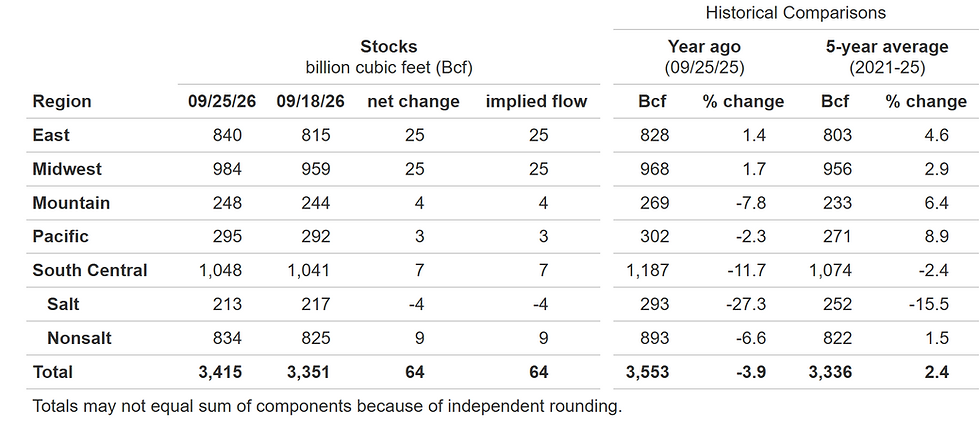
Attention is now focused on the upcoming EIA Natural Gas Storage Report, scheduled for release Thursday at 10:30 AM. Market expectations call for a 63 BCF injection into storage for the week ending September 25.
For perspective:
Expected Injection: 63 BCF
Same Week Last Year: 53 BCF
Five-Year Average: 80 BCF
The anticipated injection remains well below the historical five-year average, suggesting inventories continue to build at a slower-than-normal pace despite shoulder-season demand conditions.
This trend is particularly important because lower-than-average injections can gradually tighten end-of-season storage balances. While current inventories remain healthy, repeated below-average storage builds can create additional support heading into winter.
⚡ Energy Complex Snapshot
Broader energy markets delivered mixed signals during early Thursday trading.
As of 7:35 AM ET:
WTI Crude Oil: ▲ $1.710
Natural Gas: ▼ $0.055
Heating Oil: ▼ $0.057
Gasoline: ▲ $0.039
These mixed commodity movements reflect a market balancing economic sentiment, energy demand expectations, and evolving supply fundamentals.
For energy buyers managing multiple fuel streams, cross-commodity monitoring remains a critical component of a successful procurement strategy.
🌎 Regional Basis Markets Continue to Signal Winter Concerns
Regional basis markets remain one of the most important indicators for Northeast energy consumers.
New York Market
New York basis values moved lower for the current winter strip while remaining unchanged for the following summer months. Cash market activity was also softer across the region.
New England Market
New England basis values were also lower for the current winter strip, but notably higher for the following summer months. Cash prices moved lower across the region as well.
These basis movements suggest market participants continue adjusting winter positions while responding to evolving seasonal demand expectations.
For organizations operating throughout the Northeast, regional basis management remains just as important as NYMEX commodity pricing.
🎯 PEM Perspective: Turning Volatility Into Advantage
At Premier Energy Management, we view today's market action as another reminder that natural gas markets remain fundamentally supported despite softer weather-driven demand.
Several key themes continue to emerge:
Storage Remains Constructive
Expected storage injections continue running below five-year averages, helping support longer-term fundamentals.
The $3.00 Level Matters
The market's ability to recover above $3.00 shows buyers remain active as prices approach support levels.
Regional Opportunities Exist
Softening basis markets in portions of the Northeast may provide attractive opportunities for forward procurement and winter planning.
Winter Preparation Has Begun
Markets are increasingly looking beyond current temperatures and focusing on winter weather risk, storage adequacy, and infrastructure constraints.
PEM continues monitoring:
NYMEX Natural Gas futures
EIA storage data
Production trends
LNG export activity
Northeast basis markets
Winter weather outlooks
🔮 Looking Ahead
Several market-moving themes will remain in focus over the coming weeks:
Storage Trends
The trajectory of injections over the next month will help determine winter inventory levels.
Weather Patterns
Any shift away from mild fall temperatures could quickly alter demand expectations.
Production Levels
Supply-side developments remain a major factor in the market's ability to sustain prices above $3.00.
LNG Export Demand
International demand continues to support U.S. natural gas fundamentals.
Northeast Basis Markets
Regional volatility may create strategic procurement opportunities for commercial and industrial buyers.
Final Thoughts
Natural gas markets entered October with encouraging resilience. Despite comfortable temperatures and seasonal demand moderation, the market successfully defended key support levels and finished the session above $3.00. Combined with below-average storage expectations and ongoing production concerns, the market appears increasingly focused on winter fundamentals.
For organizations evaluating energy procurement strategies, now remains an important time to monitor market developments and assess risk-management opportunities before winter volatility fully emerges.
#NaturalGas #EnergyMarkets #PEMInsights #MarketWatch #EnergyStrategy #PremierEnergyManagement #NYMEX #EIAStorageReport #EnergyProcurement #NaturalGasStorage #BasisMarkets #CommodityMarkets #EnergyRiskManagement #IndustrialEnergy #CommercialEnergy #LNG #EnergyAnalytics #MarketVolatility #WinterOutlook #StrategicProcurement #EnergyLeadership
Winter is almost here...
Would you like a review of your facility's Winter Energy strategy? We are here to help!


Comments